What Does Hearing Loss Sound Like? Types, Causes & Signs
Find out what hearing loss really sounds like, from muffled speech to painful loud sounds. Learn the types, causes, and how hearing aids can help.

- Hearing loss usually develops slowly, so many people miss the early signs.
- There are four levels (mild, moderate, severe and profound) and three types (conductive, sensorineural and mixed).
- Conductive hearing loss comes from a blockage or problem in the outer or middle ear, and it can often be treated with medicine or a minor procedure.
- Sensorineural hearing loss is the most common type. It damages the inner ear's hair cells or hearing nerves and is usually permanent.
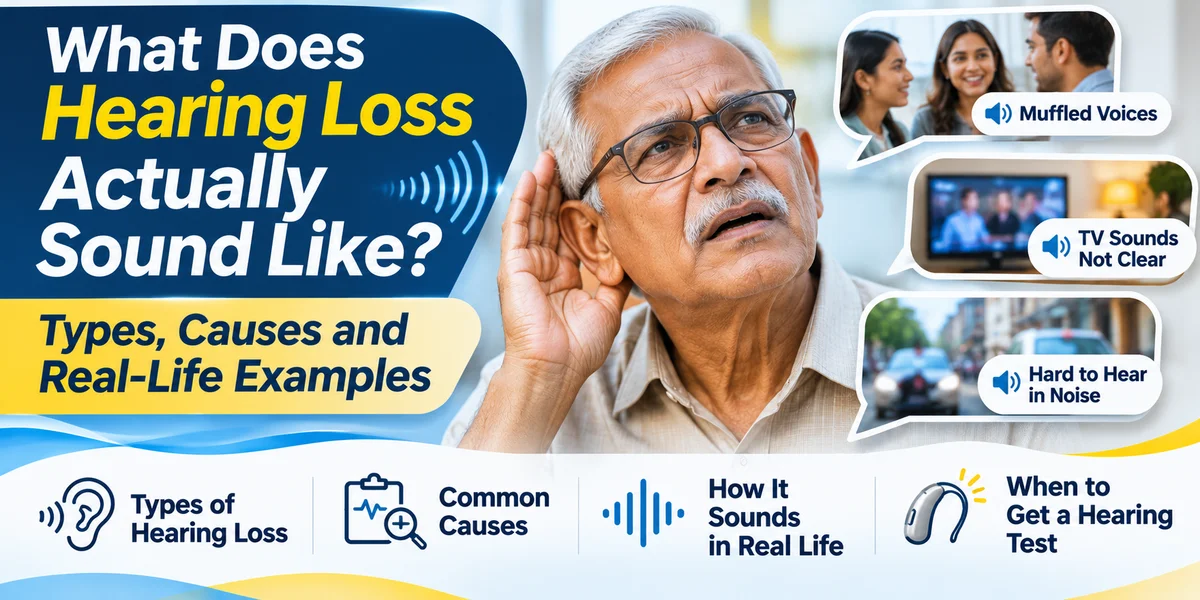
- Hearing loss can sound very different from person to person: muffled speech, missing high-pitched sounds, distorted voices, or sounds that suddenly become painfully loud.
- Modern digital hearing aids amplify the frequencies you struggle with and keep loud sounds comfortable.
What Does Hearing Loss Actually Sound Like?
Hearing loss rarely happens overnight. It tends to creep in so gradually that many people only notice it when everyday life gets harder. You might keep asking people to repeat themselves, raise the TV volume a little more each month, or start avoiding busy restaurants because conversations blur into background noise.
More than a billion people worldwide live with some degree of hearing loss. Yet if your own hearing is normal, it is hard to imagine what the world sounds like for them. Online hearing loss simulators can give you a rough idea, but first it helps to understand how hearing loss is classified.
The Four Levels of Hearing Loss
Audiologists describe hearing loss in four levels:
Mild: Soft sounds such as whispers, rustling leaves or distant talking are hard to hear.
Moderate: Normal conversational speech becomes difficult to follow.
Severe: Little or no speech is audible at a normal volume.
Profound: Only very loud sounds can be heard.
The Three Types of Hearing Loss
Hearing loss is also divided by where the problem sits in the ear. The three types are conductive, sensorineural, and mixed, which is a combination of the first two.
Conductive Hearing Loss: When Sound Cannot Reach the Inner Ear
Conductive hearing loss happens when something blocks sound on its way to the inner ear. The problem lies in the outer or middle ear. Common causes include:
Earwax buildup
An object stuck in the ear canal
Fluid trapped behind the eardrum after an ear infection
Abnormal bone growth in the ear
Tumours (less common)
People with this type often say sounds seem softer, muffled or far away. The encouraging part is that conductive hearing loss can often be treated with medication or by removing the blockage.
Sensorineural Hearing Loss: The Most Common Type
Sensorineural hearing loss occurs when the tiny hair cells in the inner ear, or the nerves connected to them, are damaged. This is the most common type, and medicine or surgery usually cannot reverse it.
The leading cause is long-term exposure to loud noise. Infections such as measles, mumps and shingles can also harm the sensory cells in the ear. Some medicines, including certain antibiotics and chemotherapy drugs, may damage hearing when taken at high doses for a long time.
How Does Sensorineural Hearing Loss Sound?
It does not sound the same for everyone. These are the most common patterns:
High-frequency loss: This is the most common pattern. Soft consonant sounds such as "s", "f" and "th" become hard to tell apart, and higher-pitched voices, like those of women and children, are harder to follow.
Low-frequency loss: This is less common. Speech sounds distorted or hollow.
Loss at both ends: Some people struggle with both low and high sounds.
Loss of clarity: The ear can no longer separate similar pitches, so voices sound smudged even when they are loud enough.
Recruitment: Healthy cells compensate for damaged ones, so sounds can jump from barely audible to uncomfortably, even painfully, loud within seconds.
Hearing simulators can help family members understand what a loved one goes through. They are only approximations, though, and they do not replace a proper hearing test.
How Hearing Aids Help
Hearing aids are the standard treatment for sensorineural hearing loss. They raise the overall volume and boost the specific frequency ranges you struggle with. Modern digital hearing aids can also make faint sounds louder and soften loud ones, which helps people who experience recruitment.
How to Protect Your Hearing
Some simple habits can lower your risk of permanent hearing damage:
Avoid prolonged exposure to loud noise.
Use earplugs or earmuffs at concerts, in workshops or on construction sites.
Keep the volume on headphones and earphones moderate.
Stay up to date on vaccines for diseases that can affect hearing.
Ask your doctor about hearing-related side effects of long-term medication.
When Should You Get Your Hearing Checked?
If you often ask people to repeat themselves, find TV volume settings creeping up, or feel that people mumble, do not wait. A hearing test with a qualified audiologist can show the type and level of your hearing loss, and finding it early gives you more options. On hearingaidnearme.in, you can find hearing aid options and clinics close to you.
FAQs
1. What does hearing loss sound like?
It depends on the type and level. Some people hear everything as muffled or distant. Others lose high-pitched sounds, so speech is audible but unclear. Some find voices distorted, or sounds that suddenly become painfully loud.
2. What are the main types of hearing loss?
Conductive hearing loss (outer or middle ear problems), sensorineural hearing loss (inner ear or nerve damage), and mixed hearing loss (both together).
3. Can hearing loss be cured?
Conductive hearing loss can often be treated with medicine or a procedure that clears the blockage. Sensorineural hearing loss is usually permanent, but hearing aids can greatly improve how well you hear.
4. What are the early signs of hearing loss?
Asking people to repeat themselves, turning up the TV or phone volume, struggling to follow conversations in noisy places, and finding it hard to understand women's or children's voices.
5. What causes sensorineural hearing loss?
Long-term loud noise exposure is the main cause. Infections like measles, mumps and shingles, and certain medicines taken at high doses for a long time, can also damage the inner ear.
6. How do hearing aids help?
They amplify sound and boost the pitches you struggle with. Modern digital models also soften sudden loud sounds, so everyday listening is clearer and more comfortable.
7. Can I test my hearing online?
Online simulators and screening tools can give you an idea of what hearing loss sounds like, but only an audiologist's hearing test can confirm your type and level of hearing loss.
More from this section

CGHS हियरिंग एड रीइम्बर्समेंट 2026: प्रति कान ₹30,000 तक, पात्रता, दस्तावेज़ और क्लेम प्रक्रिया

HearingLife Opens 20 New Clinics in 2026: 1,000 Goal Ahead

Amplifon Miracle-Ear Data Breach: What Happened & What to Do
Apple Hearing Test vs Clinic Audiometry: Is It Accurate?
Web Stories
More stories › कानात दडे बसणे: कारणे, लक्षणे आणि उपचार
 Flysound Comfort Pro: OTC AI hearing aid with remote mic
 Nuance Audio Plus: New Hearing Glasses Explained
 CGHS हियरिंग एड रीइम्बर्समेंट 2026: प्रति कान ₹30,000 तक, पात्रता, दस्तावेज़ और क्लेम प्रक्रिया
 Widex Allure AI RIC Explained: What On-Demand AI Hearing Aids Mean for Buyers in India
 आजी-आजोबांसाठी कोणती आरोग्य मशीन? मार्गदर्शन
 ब्रेकिंग न्यूज: श्रवणयंत्रावर 50% सूट | व्हिआर स्पीच अँड हिअरिंग क्लिनिक, अहिल्यानगर
 Hearing Aids November 2026: Latest Updates & Price Guide
 Oticon Hearing Aids Discontinued in India: Full List 2026
 Siemens Hearing Aid Guide 2026: Features, Prices, Benefits
Reader Comments
Comments are reviewed by our desk before they appear. Sign in with your mobile number to join the discussion.