Best Hearing Aids of 2026: Audiologist-Tested Top 10 Picks
Compare the best hearing aids of 2026, from $389 OTC models to premium prescription devices, with audiologist insights, prices, and buying tips.


- The best hearing aid depends on your hearing loss, lifestyle, and budget, not on the highest price tag.
- Elehear Beyond is the best value, with Bluetooth, tinnitus sounds, and rechargeable batteries for $431 per pair.
- Jabra Enhance Select M3 is the best OTC pick, with ReSound-based technology and three years of remote audiologist care.
- Phonak Audéo Infinio Ultra Sphere is the audiologists’ pick for hearing speech in loud places.
- OTC hearing aids suit adults with mild to moderate hearing loss only.
- Prescription hearing aids cost roughly $2,000 to $8,000 per pair, and Medicare does not cover them.
Best Hearing Aids of 2026: Audiologist-Reviewed Picks for Every Budget
The best hearing aid is the one that fits your hearing loss, daily routine, and budget. Hearing technology has improved quickly. Rechargeable batteries, Bluetooth streaming, app controls, and AI noise reduction are now common in both over-the-counter (OTC) and prescription models.
This guide compares 10 top hearing aids from a larger group of more than 70 devices evaluated by audiologists. It covers who each one suits, what it costs, and where it falls short.
Our Top Picks at a Glance
Best value: Elehear Beyond
Best OTC: Jabra Enhance Select M3
Best budget: Audien Atom X
Audiologists’ pick: Phonak Audéo Infinio Ultra Sphere
Best prescription runner-up: Oticon Intent
Best for background noise: ReSound Vivia
Most advanced features: Starkey Omega AI
Best for tinnitus relief: Widex Moment
Best invisible prescription aid: Signia Silk Charge&Go IX
Best custom-style aid: Oticon Zeal
Hearing Aid Pricing Table (2026)
Hearing Aid | Type | Price Per Pair | Best For | Trial / Warranty |
|---|---|---|---|---|
Audien Atom X | OTC | $389 | Tight budgets, quiet settings | 45-day trial, 1-year warranty |
Elehear Beyond | OTC | $431 | Best overall value, tinnitus | 45-day trial, 1-year warranty |
Jabra Enhance Select M3 | OTC | $1,995 | Premium OTC with remote care | 100-day trial, 1-year warranty |
Signia Silk Charge&Go IX | Prescription | $2,498 | Invisible, rechargeable fit | 4-year warranty plus 3-year loss and damage |
Widex Moment | Prescription | $2,798+ | Tinnitus relief, music lovers | 4-year warranty plus 3-year loss and damage |
Starkey Omega AI | Prescription | $2,998 | Advanced features, fall detection | 4-year warranty plus 3-year loss and damage |
Phonak Audéo Infinio Ultra Sphere | Prescription | $3,198 | Speech in loud noise | 4-year warranty plus 3-year loss and damage |
ReSound Vivia 9 | Prescription | $3,198 | Noisy settings, discreet size | 4-year warranty plus 3-year loss and damage |
Oticon Intent | Prescription | $3,698+ | All-around performance | 4-year warranty plus 3-year loss and damage |
Oticon Zeal | Prescription | $4,598+ | Small custom-style fit | 4-year warranty plus 3-year loss and damage |
Prices reflect remote-care provider listings and can differ in a traditional clinic, where premium prescription models often cost much more. Financing and insurance options vary by provider.
Best Value: Elehear Beyond
Type: OTC | Price: $431 per pair | Hearing loss: Mild to moderate
Elehear Beyond packs features usually found in pricier devices into a budget-friendly package. You get Bluetooth streaming, rechargeable batteries, AI-assisted noise reduction, and an app with remote fine-tuning from professionals.
What stands out:
22 tinnitus masking sounds that can play while you stream music
Lightweight receiver-in-canal design that stays comfortable all day
Clear speech in everyday environments with reduced background noise
Drawbacks:
The app takes time to learn
IPX5 water resistance is not ideal for heavy exercise
Bluetooth connection can be inconsistent when your phone is far away
Audiologist view: Dr. Jessica Hinson, AuD, recommends it for adults with mild hearing loss and tech-comfortable habits. For restaurants and busy social settings, the higher-end Beyond Pro performs noticeably better.
Best OTC Hearing Aid: Jabra Enhance Select M3
Type: OTC | Price: $1,995 per pair | Hearing loss: Mild to moderate
The Select M3 is built on ReSound technology, so it feels closer to a prescription device than most OTC options. It separates speech from background noise automatically, and it streams calls and media smoothly. Battery life reaches up to 30 hours per charge.
What stands out:
Three years of remote care from licensed audiologists
100-day risk-free trial
TapControl lets you answer calls or stream by double-tapping the device
Financing is available, including 0% APR plans
Drawbacks:
Not suited to severe or profound hearing loss
Only offered in a receiver-in-canal style
Requires some comfort with smartphones
Best Budget Option: Audien Atom X
Type: OTC | Price: $389 per pair | Hearing loss: Mild
The Atom X is a simple, rechargeable starter device with Bluetooth streaming, hands-free calling, and a touchscreen charging case that doubles as a remote. Battery life is around 12 hours, and the case includes UV cleaning.
The catch is performance. It cannot be programmed to your hearing test, and speech clarity in noise tested below average. The audiologists describe it as closer to an amplifier than a true hearing aid. It may work for people who mainly need a little extra volume at home.
Audiologists’ Pick: Phonak Audéo Infinio Ultra Sphere
Type: Prescription | Price: $3,198 per pair through remote-care provider Injoy Hearing | Hearing loss: Mild to profound
This is Phonak’s flagship, and it leads for understanding speech in crowded places. A dedicated AI chip works alongside the main processor to identify speech and suppress competing noise in real time. That helps most in busy restaurants and family gatherings.
What stands out:
Class-leading speech clarity in noise, and strong clarity in quiet too
Above-average Bluetooth music and media quality
EasyGuard receiver design to help protect against earwax buildup
Drawbacks:
Feedback control scored below the category average
Your own voice may sound less natural at first
Larger than most receiver-in-canal models
AI mode and heavy streaming drain the battery faster
In-clinic pricing can reach $6,000 to $7,000 per pair
Best Prescription Runner-Up: Oticon Intent
Type: Prescription | Price: From $3,698 per pair | Hearing loss: Mild to profound
Oticon Intent adds four built-in sensors that track conversation activity, head movement, body movement, and the surrounding environment. It uses that data to decide which sounds to prioritize. Testing showed excellent speech understanding, nearly no feedback, and strong Bluetooth streaming.
Own-voice comfort may need adjustment, and the housing is slightly bulkier than earlier Oticon models. Dr. Hinson says people who want even more noise suppression may prefer the Phonak Sphere.
Best for Background Noise: ReSound Vivia
Type: Prescription | Price: About $2,598 to $3,198 per pair | Hearing loss: Mild to profound
ReSound Vivia comes in four technology levels. The top Vivia 9 adds a dedicated deep neural network chip to separate speech from competing sounds. It uses a compact microRIE design and supports Bluetooth LE Audio and Auracast broadcasts. The app also includes a Find My Hearing Aids feature.
It requires a hearing test and professional programming. Through remote-care provider Injoy, programming and fitting happen by phone or video. Battery life drops when the noise-focused program is in heavy use.
Most Advanced Features: Starkey Omega AI
Type: Prescription | Price: $2,998 per pair through Injoy (typical clinic pricing starts around $4,000) | Hearing loss: Mild to severe
Starkey Omega AI is the successor to the Genesis AI line. Its dual-network AI engine adapts to changing environments, and feedback control is excellent. Battery life runs up to 51 hours on a charge. It also includes wellness features: activity tracking and automatic fall detection that can alert emergency contacts.
Own-voice comfort is average, the app has a learning curve, and the small buttons can be hard for people with arthritis.
Best for Tinnitus Relief: Widex Moment
Type: Prescription | Price: From $2,798 per pair | Hearing loss: Moderate to severe
Widex Moment includes Zen and SoundRelax programs that use gentle fractal tones and natural soundscapes to ease the perception of ringing. No extra hardware is needed. Its SoundSense Learn AI suggests listening settings based on your surroundings. Audiologists also recommend it for music lovers and for people with a cochlear implant in the other ear, thanks to its very short processing time.
Some users report Bluetooth pairing problems. Streaming tinnitus therapy shortens battery life, and only two of the eight Moment models are rechargeable.
Best Invisible Prescription Aid: Signia Silk Charge&Go IX
Type: Prescription | Price: $2,498 per pair | Hearing loss: Mild to moderate
This is one of the few rechargeable completely-in-canal hearing aids. Soft silicone Click Sleeves fit most ears without a custom mold. The aid is nearly invisible and improves speech clarity in busy places.
It does not support Bluetooth streaming, it is not for severe hearing loss, and its tiny size can be tricky to handle. Remote programming requires a Windows computer, so Mac users should check with the provider before ordering.
Best Custom-Style Aid: Oticon Zeal
Type: Prescription | Price: From $4,598 per pair (some sources cite around $5,000) | Hearing loss: Mild to severe
Oticon Zeal combines a small in-ear shell with rechargeable batteries, Bluetooth, and the same AI engine as the Intent. It supports Auracast and can handle mild to moderately severe loss, which is unusual for an instant-fit in-ear device.
It does not fit every ear, can be hard to insert, comes only in the top technology tier, and is not suited to profound loss.
OTC vs. Prescription Hearing Aids
The FDA created the OTC hearing aid category in 2022 for adults with perceived mild to moderate hearing loss.
OTC advantages:
Much lower prices, from about $100 to $3,000 per pair
No prescription or clinic visit required
Self-fitting with included ear domes and easy app settings
OTC limitations:
Not for severe or profound loss, and not for anyone under 18
Fewer advanced features, though many now include Bluetooth and directional microphones
Support is remote only, and online hearing tests are less detailed than an in-person audiogram
Prescription advantages:
The most advanced technology, including telecoils and premium noise processing
Suitable for all degrees of hearing loss
Fitted and programmed to your audiogram
Prescription limitations:
Typically $2,000 to $8,000 per pair, and rarely covered by insurance
Need professional programming and follow-up visits, in person or online
Hearing Aid Styles
Behind-the-ear (BTE): The largest style, with the most power.
Receiver-in-canal (RIC): A smaller body behind the ear with the speaker in the canal. It is more discreet than BTE.
In-the-ear (ITE): Sits in the outer ear, in full-shell or half-shell designs.
In-the-canal (ITC): Smaller than ITE, partly inside the canal.
Completely-in-canal (CIC): The smallest and nearly invisible, but with fewer features and harder handling.
Understanding Your Hearing Loss
Types: Low-frequency loss affects sounds below 2,000 Hz, such as vowels and rumbling. High-frequency loss affects 2,000 to 8,000 Hz, making children’s voices and consonants like “s” hard to hear. Conductive loss comes from problems in the outer or middle ear. Sensorineural loss involves the inner ear or auditory nerve and needs prompt medical attention.
Degrees: Mild loss falls around 25 to 40 dB, moderate around 41 to 55 dB, severe around 56 to 90 dB, and profound above about 90 dB. OTC aids are approved only for mild to moderate loss.
Tinnitus: Hearing aids cannot cure it, but amplifying everyday sound and playing masking tones can make ringing less noticeable.
How to Buy Hearing Aids
Get a hearing test. An audiologist can confirm the type and degree of your loss and say whether OTC or prescription is appropriate.
Stick to reputable brands. Some products sold as hearing aids are simple amplifiers with no noise filtering.
Check return policies. Trials of 30 days or longer give you time to decide.
Ask about support. Remote fine-tuning and warranty terms matter as much as the device.
Check financing and insurance. Many providers offer payment plans, and some Medicare Advantage plans include hearing benefits.
Frequently Asked Questions
Do more expensive hearing aids work better?
Not always. Higher-priced devices usually have more advanced processors and features, which can help with severe loss or noisy settings. A well-fitted mid-priced device can outperform a poorly programmed premium one. OTC aids are not recommended for severe to profound loss.
How much does one hearing aid cost?
OTC hearing aids are usually sold in pairs. A single prescription hearing aid typically costs between $1,000 and $3,500, depending on technology level.
What is the average cost of hearing aids?
Prescription pairs run about $2,000 to $8,000. OTC pairs range from roughly $100 to $3,000.
Are behind-the-ear hearing aids better than in-the-ear?
Neither is better by default. If the device is programmed to your hearing test, the choice comes down to comfort, discretion, and features. In-ear styles are more discreet, while behind-the-ear models often offer more power and battery life.
Does Medicare cover hearing aids?
Original Medicare does not cover hearing aids or fitting exams. Some Medicare Advantage plans offer hearing benefits, and some private insurance plans cover part of the cost, though this is uncommon.
What batteries do hearing aids use?
Hearing aids use either disposable batteries that must be replaced or rechargeable ones that charge overnight like earbuds.
What is the best hearing aid for speech clarity?
For speech in noisy places, our audiologists’ top picks are the Phonak Audéo Infinio Ultra Sphere and ReSound Vivia 9. Among OTC options, the Jabra Enhance Select M3 stands out.
Should I see an audiologist before buying?
Yes, if you can. A professional evaluation rules out medical causes and helps you choose the right device.
More from this section
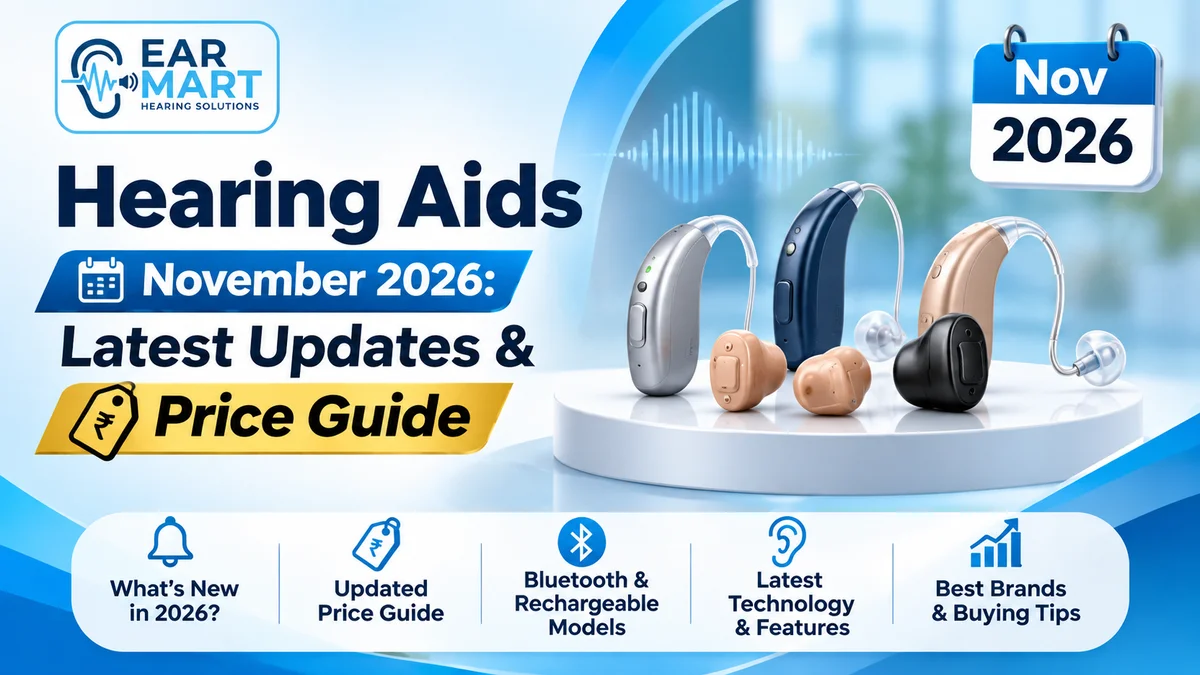
Hearing Aids November 2026: Latest Updates & Price Guide

स्टारकी हिअरिंग एड किंमत 2027 | ज्येष्ठ नागरिकांसाठी सर्वोत्तम मॉडेल

रीसाउंड श्रवणयंत्र किंमत भारत 2026: ज्येष्ठ नागरिकांसाठी सर्वोत्तम मॉडेल्स
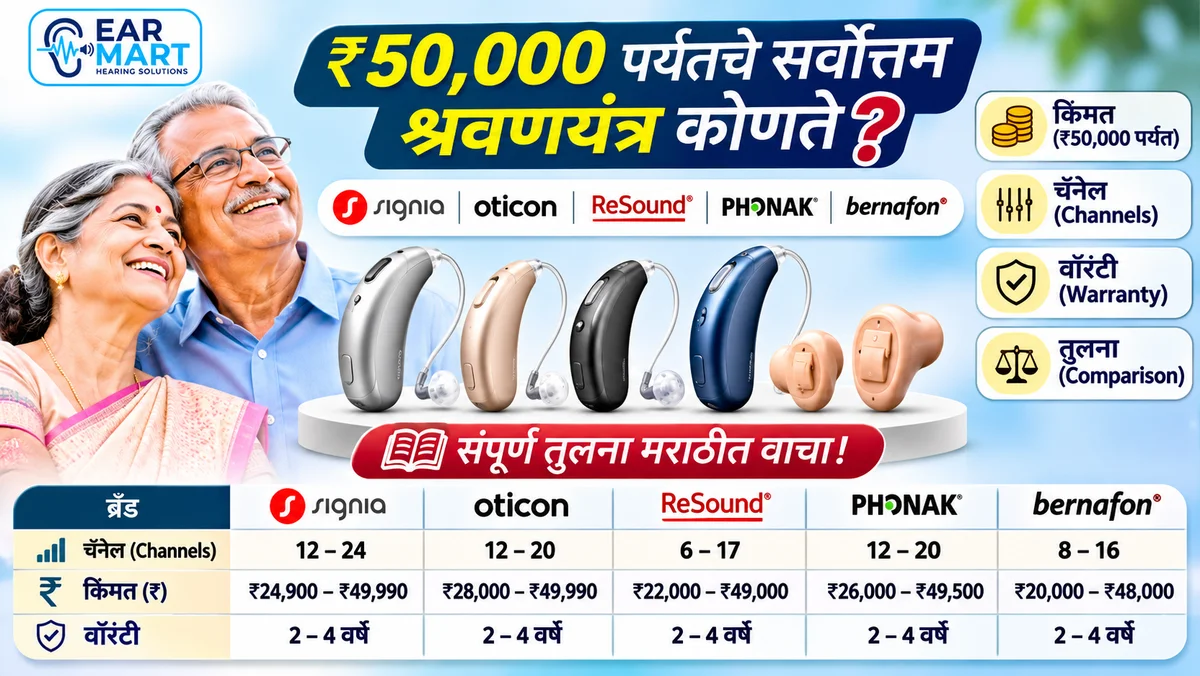
₹50,000 च्या आत सर्वोत्तम श्रवणयंत्र 2026: सर्व ब्रँडची तुलना, किंमत आणि माहिती
Web Stories
More stories ›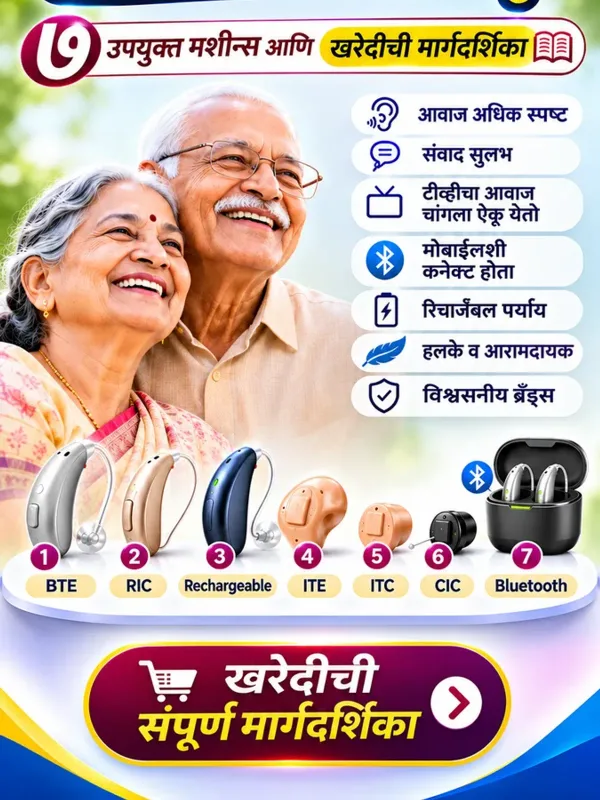 आजी-आजोबांसाठी कोणती आरोग्य मशीन? मार्गदर्शन
 ब्रेकिंग न्यूज: श्रवणयंत्रावर 50% सूट | व्हिआर स्पीच अँड हिअरिंग क्लिनिक, अहिल्यानगर
 Hearing Aids November 2026: Latest Updates & Price Guide
 Siemens Hearing Aid Guide 2026: Features, Prices, Benefits
 Phonak Hearing Aid Latest Update 2026: New EON Series, Features, Price and Availability
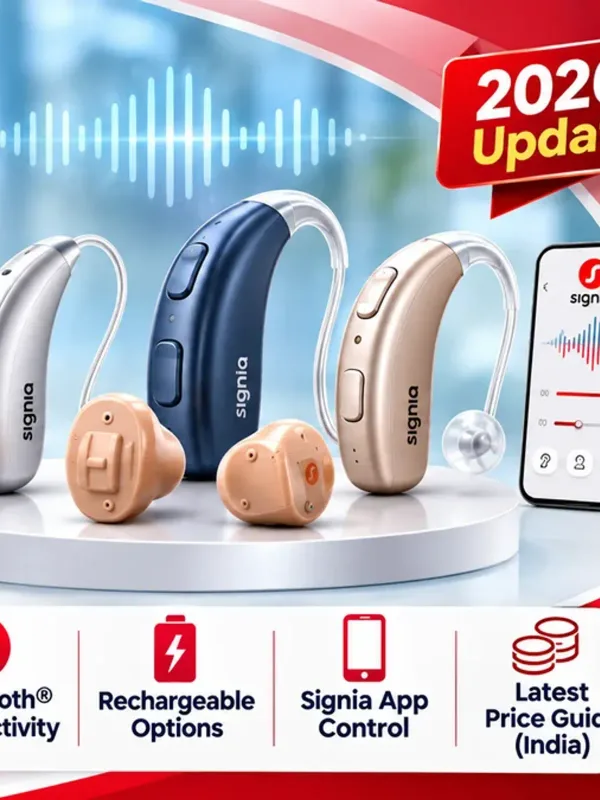 Signia Hearing Aid Latest Update 2026: New MaX AI Hearing Aid, Features and Prices
 Widex Hearing Aid Latest Update 2026: Allure AI & Price
 Oticon Reveal 2026: Dual AI hearing aid, features and price
Reader Comments
Comments are reviewed by our desk before they appear. Sign in with your mobile number to join the discussion.