Best Hearing Aids 2026: Lab-Tested Picks, Prices & Scores
Compare the best hearing aids of 2026 using lab-tested SoundScores. See top prescription and OTC picks, real prices, and which model suits noisy rooms.

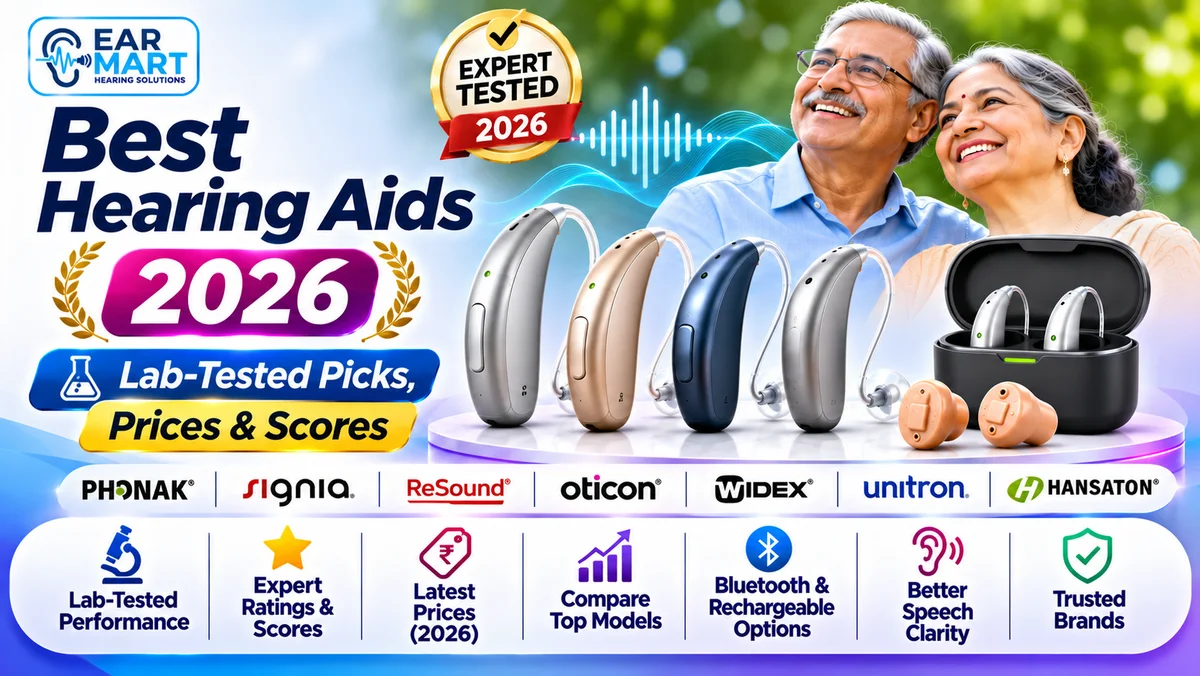
Pick Fortell if noisy-room clarity is your top priority and budget allows. Choose Phonak Audéo EON Sphere for a strong prescription option with professional tuning at a lower price. Go with Elehear Beyond Pro for the best performance under $600, or Yeasound RIC800 for streaming and quiet-setting clarity in a receiver-in-canal style. Whatever you choose, pair lab data with a hands-on trial.
- Fortell AI Hearing Aids has the top SoundScore of 2026 at 6.0
- Fortell also posts the best speech-in-noise result the lab has measured, 6.4 at the initial fit
- Phonak Audéo EON Sphere is the prescription runner-up, scoring 5.0 and improving with professional tuning
- Elehear Beyond Pro is the best pick under $600, scoring 4.2 with excellent feedback control
- Yeasound RIC800 is the best-value receiver-in-canal aid at $659, scoring 4.7
- That Yeasound score beats 24 of the 32 prescription devices on the leaderboard
Hearing aids in 2026 come loaded with AI, streaming, and rechargeable batteries. Yet two devices with similar spec sheets can sound very different, especially when background noise gets loud. Manufacturer claims won’t tell you that. Independent lab measurements will.
This guide ranks hearing aids using standardized lab data from HearAdvisor, covering both prescription and over-the-counter (OTC) models. Each device is programmed for the same mild-to-moderate hearing loss and recorded on an acoustic manikin in a controlled chamber. The results become a SoundScore you can compare across brands and price points.
Below you’ll find the top picks, a full pricing table, how the scoring works, and answers to common questions.
Best Hearing Aids of 2026 at a Glance
Best overall (prescription): Fortell AI Hearing Aids. SoundScore 6.0, about $6,800 per pair.
Best prescription runner-up: Phonak Audéo EON Sphere. SoundScore 5.0, about $3,498 per pair.
Best under $600 (OTC): Elehear Beyond Pro. SoundScore 4.2, $599 list price (a promo code brought it to $559).
Best value receiver-in-canal (OTC): Yeasound RIC800. SoundScore 4.7, $659 per pair.
These are audiologist picks, not simply the highest numbers. They weigh speech in noise, how much professional tuning improves results, price, and availability.
1. Fortell AI Hearing Aids: Best for Noisy Conversations
SoundScore: 6.0 (Grade A) | Prescription | Behind the ear | About $6,800 per pair
Fortell leads the 2026 leaderboard by 0.9 points over the next device. Its standout result is speech in noise: 6.4 at the initial fit and 6.0 after tuning, the strongest figure the lab has recorded on any device. Speech in quiet reached 5.4 initially and 4.6 tuned, and music streaming held steady at 4.2.
The weak spot is own-voice quality, which scored just 1.5 in both fits. If you’re sensitive to how your own voice sounds through hearing aids, discuss that with your provider.
Best for: people who struggle in restaurants, family gatherings, and other busy rooms, and who want a professional fitting.
2. Phonak Audéo EON Sphere: Best Prescription Runner-Up
SoundScore: 5.0 (Grade A) | Prescription | Behind the ear | About $3,498 per pair
The EON Sphere shows how much a good fitting matters. Its speech-in-noise score rises from 3.7 at the initial fit to 4.5 once tuned. It also handles feedback well (4.6), scored 4.3 for speech in quiet, and reached 3.7 for music streaming. With a more closed dome, it performed close to Fortell in noise.
Best for: active people who spend time in loud places and will get real-ear verification from an audiologist.
3. Elehear Beyond Pro: Best Under $600
SoundScore: 4.2 (Grade A) | OTC | Behind the ear | $599 list price
Elehear Beyond Pro is the value leader for budget shoppers. It scored 5.0 for feedback handling, 3.8 for music streaming, 3.3 for speech in quiet, and 2.5 for speech in noise. Initial and tuned results were identical, so it performs the same out of the box as it does after adjustment.
Best for: adults with mild-to-moderate loss who want whistle-free everyday sound and don’t mind a slightly larger behind-the-ear design.
4. Yeasound RIC800: Best Value Receiver-in-Canal
SoundScore: 4.7 (Grade A) | OTC | Receiver-in-canal | $659 per pair
The RIC800 delivers strong quiet-room clarity (4.4), music streaming (4.3), and top-tier feedback control (5.0). Speech in noise is its weakness at 2.4, and own-voice quality scored 2.1. It suits calmer settings best.
Best for: quiet conversations, TV, and music streaming on a modest budget.
2026 Hearing Aid Pricing Table
Prices are per pair and can change by retailer, clinic, and promotion. Where an exact price wasn’t published, the table shows the price tier instead of a guess.
Hearing Aid | Type | SoundScore | Price (per pair) |
|---|---|---|---|
Fortell AI Hearing Aids | Prescription | 6.0 | About $6,800 |
Oticon Reveal 1 miniRITE | Prescription | 5.1 | Premium tier ($$$$$) |
Phonak Audéo EON Sphere | Prescription | 5.0 | About $3,498 |
Phonak Sphere Infinio Ultra | Prescription | 4.9 | Premium tier ($$$$$) |
Oticon Intent | Prescription | 4.8 | Premium tier ($$$$$) |
Yeasound RIC800 | OTC | 4.7 | $659 |
Oticon Real | Prescription | 4.7 | Upper tier ($$$$) |
Oticon Zeal (invisible in ear) | Prescription | 4.7 | Premium tier ($$$$$) |
Widex Allure RIC 440 | Prescription | 4.7 | Premium tier ($$$$$) |
Signia Active Pro IX | Prescription | 4.6 | Upper tier ($$$$) |
Elehear Beyond Pro | OTC | 4.2 | $599 list |
What the price tiers mean: prescription aids are often sold in packages that include fittings, follow-up visits, and warranties, so the final cost depends on the clinic. OTC devices are bought directly and need no appointment, but you do the setup yourself.
2026 SoundScore Leaderboard: Speech in Noise Results
Speech in noise is the toughest test for any hearing aid, and this is where devices separate. “Initial” is the factory first fit and “Tuned” is after professional optimization.
Device | SoundScore | Speech in Noise (Initial) | Speech in Noise (Tuned) |
|---|---|---|---|
Fortell AI Hearing Aids | 6.0 | 6.4 | 6.0 |
Oticon Reveal 1 miniRITE | 5.1 | 3.2 | 3.3 |
Phonak Audéo EON Sphere | 5.0 | 3.7 | 4.5 |
Phonak Sphere Infinio Ultra | 4.9 | 3.1 | 4.5 |
Oticon Intent | 4.8 | 3.5 | 3.1 |
Yeasound RIC800 | 4.7 | 2.4 | 2.4 |
Oticon Real | 4.7 | 3.0 | 2.9 |
Oticon Zeal | 4.7 | 2.7 | 3.0 |
Widex Allure RIC 440 | 4.7 | 3.0 | 2.3 |
Signia Active Pro IX | 4.6 | 2.8 | 2.9 |
Key takeaways:
Fortell is far ahead of the field for noisy settings.
Tuning helps the Phonak models most. The Sphere Infinio Ultra jumped from 3.1 to 4.5, the largest gain measured.
The Widex Allure actually scored lower after tuning (3.0 to 2.3), so tuned results aren’t always better.
How SoundScore Works
SoundScore is a lab-measured rating of sound performance. Every device is programmed for the same common mild-to-moderate loss and tested on five metrics: speech in quiet, speech in noise, music streaming, feedback handling, and own voice.
The overall score weights the initial fit at 77% and the tuned fit at 23%, then adds a fixed 1.1 points so results land in a familiar star-style range. Scores aren’t capped at 5.0. That’s why Fortell can reach 6.0.
Score guide:
Below 4.0: no award
4.0 and up: Expert Choice
4.4 and up: top quarter of ranked devices
Out of 69 hearing aids currently ranked, 34 reach Expert Choice. The testing uses a standardized hearing loss profile, a KEMAR acoustic manikin, and a treated test chamber. More than 100 models have been tested so far.
OTC vs Prescription: Which Should You Choose?
OTC hearing aids can compete with prescription models, at least in lab conditions. The Yeasound RIC800 outscored 24 of 32 prescription devices on the leaderboard. But there are limits to keep in mind:
Severity of hearing loss. OTC aids are built for mild-to-moderate loss. Prescription devices can provide much more power for severe or profound loss.
Fitting quality. The lab tunes every device with professional tools. At home, most people won’t reach those settings. An audiologist using real-ear measurements can usually get both types close to their best.
Noisy environments. The strongest speech-in-noise performers are prescription devices.
Support. Prescription purchases usually include adjustments and follow-up care.
If you have a mild loss, a limited budget, and mostly quiet listening, OTC is a smart place to start. If you have more significant loss or need help in noisy places, see an audiologist.
What Lab Scores Can’t Tell You
SoundScore measures sound performance. It does not measure comfort, battery life, durability, app quality, or how a device feels in your ears. Your own hearing loss may also differ from the one used in testing. Before buying, try the device, confirm the return policy, and have a hearing professional verify the fit.
Frequently Asked Questions
What is the best hearing aid in 2026?
Based on lab testing, Fortell AI Hearing Aids holds the top SoundScore at 6.0 and the best speech-in-noise result measured so far. Phonak Audéo EON Sphere is the runner-up at 5.0.
What is the best OTC hearing aid?
Yeasound RIC800 is the top-scoring OTC model at 4.7. Elehear Beyond Pro (4.2) is the best choice under $600.
How much do hearing aids cost per pair?
In this guide, OTC models range from about $599 to $659, while the prescription models with published prices run from about $3,498 to $6,800. Many other premium prescription models sit in similar upper price tiers.
Do OTC hearing aids work as well as prescription ones?
Sometimes, for mild-to-moderate loss. One OTC model outscored 24 of 32 prescription devices in the lab. Prescription aids still lead for noisy environments and more severe hearing loss.
What is a good SoundScore?
A score of 4.0 or higher earns Expert Choice, and 4.4 or higher places a device in the top quarter. The highest score today is 6.0.
What is the difference between initial and tuned fit?
The initial fit is the device’s performance right out of the box. The tuned fit is performance after optimization. The overall score weights the initial fit more heavily because most people never get perfectly tuned settings.
Why do some prescription hearing aids score low at the initial fit?
Manufacturers’ first-fit software often favors comfort over speech clarity, which can lower the initial score. Professional tuning can fix this, as the Phonak results show.
Is a hearing aid with a score below A bad?
Not necessarily. Lower default amplification can reduce a score, and a lower-priced device with a B grade can still be excellent value.
What is the difference between open-fit and closed-fit hearing aids?
Open-fit aids leave the ear canal unsealed for a more natural sound and no “barrel” effect on your own voice. Closed-fit aids seal the canal, which can help in noise and for streaming but reduces awareness of surrounding sounds.
How should I listen to audio comparison samples?
Use quality headphones in a quiet room. Set the volume so the open-ear sample sounds realistic, and don’t change it between samples. Remove your own hearing aids first.
Do I need an audiologist?
Not required for OTC devices, but a professional fitting is strongly recommended for any hearing loss beyond mild, and it unlocks the best results from prescription models.
More from this section

Web Stories
More stories › ब्रेकिंग न्यूज: श्रवणयंत्रावर 50% सूट | व्हिआर स्पीच अँड हिअरिंग क्लिनिक, अहिल्यानगर
 Hearing Aids November 2026: Latest Updates & Price Guide
 Siemens Hearing Aid Guide 2026: Features, Prices, Benefits
 Phonak Hearing Aid Latest Update 2026: New EON Series, Features, Price and Availability
 Signia Hearing Aid Latest Update 2026: New MaX AI Hearing Aid, Features and Prices
 Widex Hearing Aid Latest Update 2026: Allure AI & Price
 Oticon Reveal 2026: Dual AI hearing aid, features and price
Reader Comments
Comments are reviewed by our desk before they appear. Sign in with your mobile number to join the discussion.